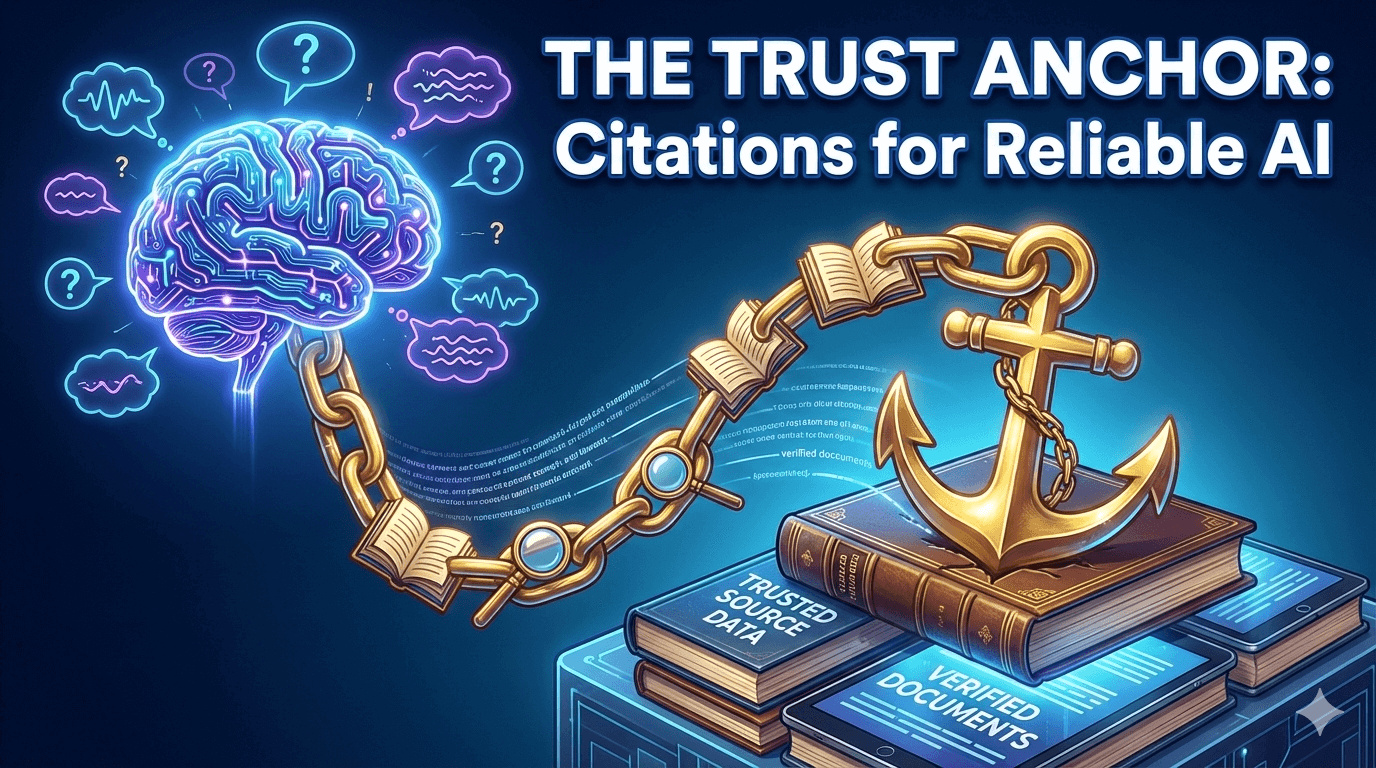
Moving beyond the chatbot. How implementing rigorous citation mechanisms turns generative AI from a creative fabulist into a reliable business tool.
The initial wave of excitement surrounding Large Language Models (LLMs) was driven by their almost magical ability to converse fluently on any topic. But as enterprises move from playground prototypes to production applications, the hangover is setting in. We are rediscovering an uncomfortable truth: eloquence is not the same as accuracy.
LLMs are notoriously confident. They will deliver a completely fabricated fact with the same authority as a verified truth. In the industry, we politely call these “hallucinations.” In a business context—whether in legal, finance, or healthcare—a hallucination isn’t just a quirky glitch; it’s a liability.
If we want to build LLM applications that serious professionals can rely on, we have to solve the trust problem. The solution isn’t just bigger models or better prompting.
The solution is citations.
Here is why implementing citations is the single most effective architectural decision you can make to combat hallucinations in LLM applications.
The Root Cause: Why Models “Lie”
To understand why citations cure hallucinations, we must understand the disease.
LLMs are not knowledge bases. They do not “know” facts in the way a database does. They are massive probabilistic engines optimized to predict the next statistically likely token in a sequence. When asked a question outside its training data, or when its internal weights get “fuzzy” on a specific detail, the model doesn’t stop; it guesses. It fills the gap with something plausible-sounding, but factually empty.
An LLM without access to external data is like a brilliant scholar locked in an empty room with only their memory. Eventually, they will start misremembering details.
The Fix: Grounding via Retrieval-Augmented Generation (RAG)
To fix this, we stop asking the model to rely solely on its memory. Instead, we use architectures like Retrieval-Augmented Generation (RAG).
Before the LLM answers a user query, the application first searches a trusted knowledge base (your company documents, PDFs, verified databases) for relevant information. It then pastes that information into the prompt and says to the LLM: “Only answer the user’s question using the information provided below.”
This process is called “grounding.” But grounding alone isn’t enough. You need proof that the grounding worked.
How Citations Act as the Anti-Hallucination Mechanism
Citations are the visible artifact of a successful RAG process. They change the fundamental relationship between the user and the AI in four critical ways:
1. The Shift from Creation to Reference
When an LLM is forced to cite its sources, its role shifts from “creative writer” to “research assistant.” The requirement to append a citation acts as a constraint. If the model cannot attribute a claim to a specific chunk of retrieved text, the system should be designed to reject that claim. The citation forces the model to show its work.
2. Enabling “Human-in-the-Loop” Verification
Trust, but verify. Even the best RAG systems sometimes retrieve the wrong document or misinterpret a nuance in the text.
Without citations, the user has to accept the AI’s output blindly. With citations, a subject matter expert—a lawyer reviewing a contract summary or a doctor reviewing patient history—can hover over a claim, click the source link, and instantly read the original context. This turns a “black box” output into verifiable evidence.
3. Combatting Confident Errors with “Abstention”
The most dangerous AI is one that is confidently wrong. A robust citation system allows developers to program for “abstention.”
If the retrieval system finds no relevant documents, or if the LLM cannot connect the retrieved documents to the user’s question, the application should not attempt an answer. It should state: “I cannot find information about that in your source documents.”
A system that admits ignorance is infinitely more trustworthy than one that fabricates an answer. Citations are the mechanism that enables this self-awareness.
4. Solving the Data Freshness Problem
LLM training data is frozen in time. GPT-4 doesn’t know what happened on the news yesterday.
If your application needs to deal with real-time data—stock prices, recent regulatory changes, or new internal policies—citations are mandatory. They prove that the model isn’t hallucinating based on outdated training data, but is instead referencing the most current retrieved document. The citation serves as a timestamp of truth.
Conclusion: Citations Are a Safety Feature
We need to stop thinking of citations as an academic nicety and start viewing them as an essential safety feature for enterprise software.
If you are building an application to generate marketing copy, a few creative hallucinations might be acceptable. But if you are building an application to summarize legal briefs, analyze financial risks, or support clinical decisions, zero-shot reliance on an LLM’s internal memory is professional malpractice.
To move AI from a novelty to a core business tool, we must bridge the gap between stochastic generation and verifiable fact. That bridge is built with citations.